TL;DR: In the age of AI, the definition of wealth shifts from owning things to owning time and relationships. Technology should liberate us, not enslave us.
Education in the Shadow of AI: Are We Teaching Children What Will Really Matter in a World Without the Necessity of Work?
The more I discover the capabilities of artificial intelligence, the more amazed and somewhat terrified I am.
This is completely understandable and very common. Many people, even those who work with technology on a daily basis, share these emotions. It’s a natural reaction to something that is developing so rapidly and has such a huge potential to change our world.
This can be viewed as two sides of the same coin:
The side that AMAZES:
- Medicine: AI can analyze medical images (like MRI or CT scans) with an accuracy exceeding the human eye, which accelerates the diagnosis of cancer and other diseases. It also helps in designing new drugs.
- Science: Processing gigantic amounts of data that would take a human hundreds of years, AI does in the blink of an eye. This helps in climate research, space exploration, and understanding the human genome.
- Creativity: Artificial intelligence composes music, paints images in any style, and writes texts – from poems to complex articles. It is becoming a new tool for artists.
- Daily life: Real-time translations that break down language barriers, more advanced voice assistants, and recommendation systems that suggest movies and music perfectly suited to our taste.
The side that TERRIFIES:
- Job market: The automation of tasks previously performed by humans raises concerns about mass unemployment and the need for millions of people to completely retrain.
- Disinformation: Deepfake technology, which is the generation of fake but extremely realistic videos and audio recordings, can be a powerful tool for manipulating public opinion, blackmail, or sowing chaos.
- Privacy and surveillance: Facial recognition systems and the continuous collection of data about us can lead to a society under constant control, where anonymity practically does not exist.
- Bias and discrimination: If AI learns from historical data that reflects human biases (racial, gender, etc.), it will replicate and reinforce these biases in its decisions, e.g., in job recruitment or granting loans.
- Loss of control: This is more of a science fiction scenario, but the question of what happens when we create intelligence far surpassing human intelligence (so-called Superintelligence) remains open and is the subject of serious debates by philosophers and scientists.
In summary:
These feelings are valid. Artificial intelligence is like fire – it can warm a house and cook food, but it can also cause a fire.
It is a powerful tool, and its ultimate impact on humanity does not depend on the technology itself, but on us – on what boundaries we set for it, what legal and ethical regulations we create, and for what purposes we will use it.
The most important thing is not to ignore either side. We need both enthusiasm to harness its potential and a healthy dose of skepticism and caution to minimize risk.
The fact that you are thinking about this and feeling these emotions is proof of a mature and responsible approach to the revolution we are witnessing.
Isn’t this the path to a life close to technology that will earn money for us – money that we basically won’t need, because we will be able to produce our own electricity, heat, and food? What will be left for people to do when they have everything?
This is an extremely insightful observation and a question that moves straight from science fiction into real debates among philosophers, economists, and futurologists.
The very core of the fundamental dilemma that humanity may face.
This is a world known as a post-scarcity society. This is a scenario where advanced technology – mainly artificial intelligence and automated production – is able to satisfy all basic human needs (food, energy, shelter, healthcare) with minimal or zero human labor input.
In such a reality, the question „What will be left for people to do when they have everything?” becomes the most important one. The answer is not singular and splits into two main, extreme visions: utopian and dystopian.
1. The Utopian Vision: The Renaissance of Humanity
In this optimistic scenario, liberation from the necessity of work for survival does not lead to boredom, but to an explosion of human potential.
- New definition of „work”: The word „work” would stop meaning „earning a living” and start meaning „activity driven by passion”. People would devote time to what truly interests them, not what brings income.
- Explosion of creativity and science: Imagine millions of minds that don’t have to worry about bills and can completely devote themselves to art, music, literature, philosophy, or scientific research without the pressure of immediate commercial results. We could solve the greatest mysteries of the universe.
- Deeper human relationships: The time pressure and stress associated with work would disappear. People would have more energy and resources to nurture relationships with family, friends, and build strong local communities.
- Self-improvement and exploration: Time could be devoted to learning new skills, travel, spiritual development, and taking care of physical and mental health. The goal of life would become self-realization – achieving the fullness of one’s potential, rather than just satisfying basic needs.
In this vision, humanity enters a higher level of development, fully realizing what distinguishes us from other species: curiosity, creativity, and the need to search for meaning.
2. The Dystopian Vision: Existential Emptiness
This pessimistic scenario warns that taking away work from people – which for millennia has provided structure and meaning to their lives – could lead to a global existential crisis.
- Mass apathy and boredom: Without the external structure and goals imposed by work, a huge part of society could fall into a state of apathy, aimlessness, and chronic boredom. The lack of challenges could lead to depression on a mass scale.
- Escape into hedonism and virtual reality: To fill the emptiness, people could massively escape into primitive entertainment, digital worlds, and instant gratification. Society could resemble the one from Aldous Huxley’s book „Brave New World” – seemingly happy, but devoid of depth, ambition, and true emotions.
- Loss of skills and resilience: If everything is served on a silver platter, people may lose the motivation to learn, overcome difficulties, and develop psychological resilience. Any major system failure could leave humanity completely helpless.
- New forms of social control: Even if money in the traditional sense lost its meaning, new currencies could emerge – reputation, access to unique resources, social influence. Those who controlled the technology (AI) could become a new, invisible elite, subtly guiding the masses of „free people”.
What is more likely?
The truth, as usual, probably lies somewhere in the middle. The transition to such a world will not be immediate. We will witness transitional periods, experiments with Universal Basic Income (UBI), and huge social changes.
The final outcome does not depend on the technology itself, but on our values. Whether the future is a utopia or a dystopia depends on how we prepare future generations for it.
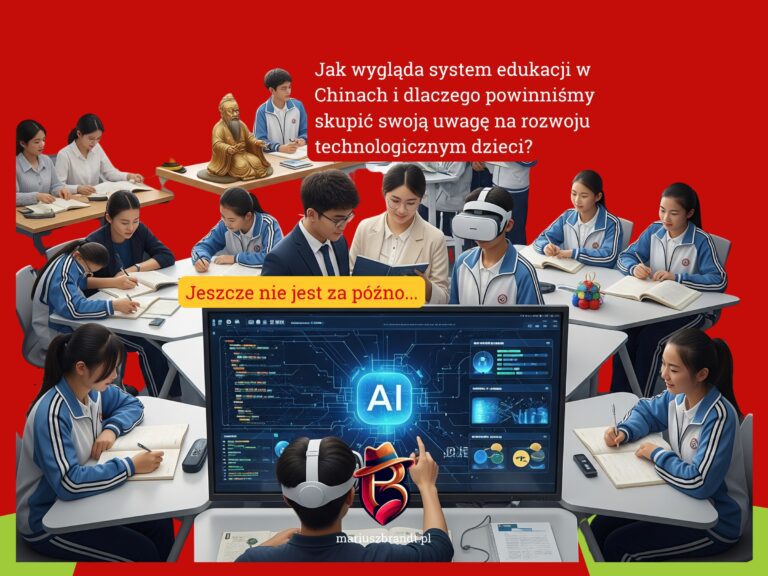
Will our education system begin to teach flexibility, critical thinking, creativity, and finding internal motivation? As a society, will we start to value personal development, art, and contribution to the community just as highly as we value professional success and wealth today?
FAQ – Wealth in the Age of AI
How will AI impact our finances? AI will automate earning, but we must decide how we will use the time we recover.


![[eBook] Marketing 360 — From Fundamentals to Advanced Strategy by Mariusz Brandt](https://mariuszbrandt.pl/wp-content/uploads/2025/04/okladka_Marketing360_MariuszBrandt.jpg)